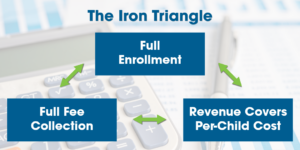
 Child care budgets often focus on money coming in (revenue/tuition collected) and money going out (expenses). But in child care, there are two other important pieces: Full enrollment and full fee collection.
In early childhood education, we refer to full enrollment, full fee collection and revenue cover per child as the “Iron Triangle.” Let’s explore what that means and how it can help with your program’s budget.
Full Enrollment
The majority of child care programs revenue is based on enrollment. Monitor your enrollment and adjust if you have open seats. Keep a waitlist of potential families interested in joining your program and then reach out to them as soon as a spot opens up.
Full Fee Collection
Collecting tuition on time and in full is the only way your program will create revenue. Child costs are an increasing burden on families and providers, but keep in mind that in order for fees to become revenue, you must collect payments/tuition.
Revenue
Setting your tuition fees accurately will give you the appropriate rate of revenue per child. Sometimes this is out of your control. It is important that you know how much it costs to provide care for each child in your program. Let that guide you on setting tuition rates.
Both full enrollment and full fee collection impact revenue cost per child. They all work together to complete a child care program budget. If you are in need of support for your program, contact our Business Services team at businessservices@4cforchildren.org.